TRANSVAAL BLASTING CERTIFICATES
Jeff WoolgarThe illustrations below, (Ex. Joan Matthews), are three ‘Blasting Certificates’ issued in the Transvaal Colony at Johannesburg, Germiston and Krugersdorp, between 1903 and 1907.
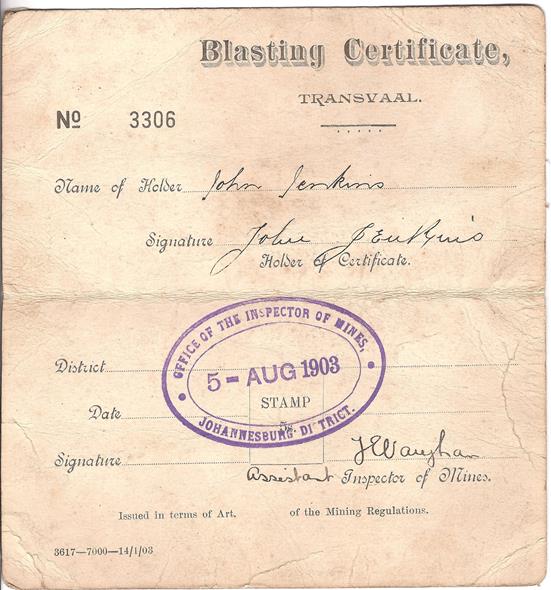
At lower left of the blasting certificate illustrated above, the imprint provides us with the order number '3617' quantity required '7000' and the date of order 14th January 1903. As was common at the time, a legacy of Victorian design, several different founts* have been used, including drop-letters for 'Blasting Certificate'. The design of such printed matter was regularly left to the compositor, who used the printing type and ornaments at his disposal and to his fancy.
The Certificate is signed by the mining engineer, John Jenkins and the Assistant Inspector of Mines, H. Vaughan at the Office of the Inspector of Mines, Johannesburg district. The clear purple handstamp is set at '5 – AUG 1903' and the blasting certificate has been roughly folded horizontally by use of an improvised score.
Clearly the rectangle for the stamp 'STAMP / 5s.' has never received an adhesive revenue stamp. The notification requiring the use of adhesive stamps on Blasting Certificates was published in the Transvaal Government Gazette of 31st July, 1903, although it was probably not until some weeks after publication that the first adhesive stamps would have been applied.
The high print run of 7000 is not surprising given the number of men employed by the various mining companies in the Transvaal Colony and the continual change of staff. The average working life of a blasting engineer was understood to be eight years, although many endeavoured to continue for longer periods. Their health was impaired by their drinking habits, mainly spirits, while the physical conditions of working underground shortened the lives of many as they continually breathed in the deadly quartz dust. In some mines it was the practice to ignite just one of the many explosives to enable the blasting engineer to return to the gallery, which was full of dust and dynamite smoke, to assess the rock fall and to set the remaining fuses to the best advantage. A man who stayed too long on the mines could suffer from phthisis, the effect of which meant that he could find it difficult to live at lower altitudes and eventually lead to his demise.
The Mining Certificates Ordinance 1903.
The rules specifying the subjects in which candidates were examined were published from time to time in the The Transvaal Government Gazette and in one or more newspapers. There were two certificates, a provisional and a permanent. These were in the form prescribed by the Government Mining Engineer and obtained at the office of the Inspector of Mines. They were examined by the manager or overseer upon engagement at a mine and retained until the termination of engagement.
The fee was prescribed by Regulations framed by the Lieutenant Governor under the Ordinance. This fee appears to have remained at five shilling for a permanent Blasting Certificate during the period covered here, August 1903 to 1907.
If a certificate was lost, the Inspector of Mines or Manager was authorised to issue a new certificate provided the new one carried the word “duplicate”.
Misdemeanours or any breach of blasting regulations could result in the manager suspending either a provisional or permanent certificate immediately and reporting the matter to the Inspector of Mines. Rule 27 gave the Inspector of Mines the power to cancel a certificate at any time. Any person who obtained or attempted to obtain a certificate illegally or presented a false document was liable to a fine of up to £75 and if in default, a prison sentence of up to six months with or without hard labour.
The holder of the certificate was responsible for the safety of all persons not in possession of such a certificate, while the ganger who was not the holder, but in charge of natives, had to be satisfied with the safety of the workplace. An interesting rule for safety was expressed in section VIII and headed 'Explosives'. Whilst carrying explosives a person was not permitted to carry a light. Underground they were required to be preceded by a person carrying a light, whose duty was to give proper warning of the approach of explosives. Persons handling or carrying explosives were not permitted to smoke.
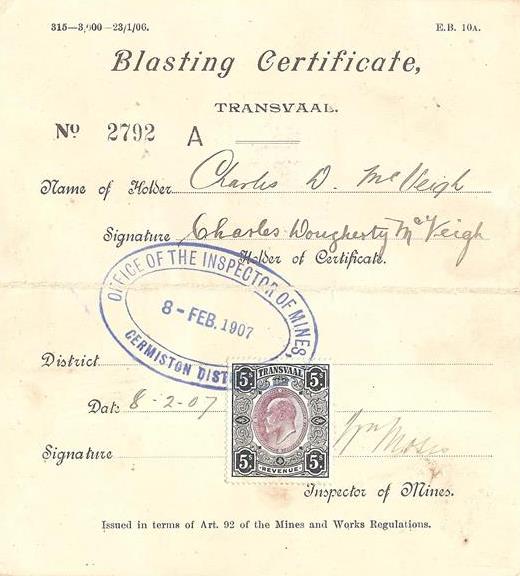
The Blasting Certificate was issued at Germiston on 8th February, 1907. Printed black on thick cream pulp board lined with light blue paper on the reverse. The horizontal crease running across the middle was probably intended to enable it to be folded in half. The open size is 154.5mm x 142mm. Printed top left is the order number, '315', the quantity printed, '3000', and the date, '23/1/06.'.
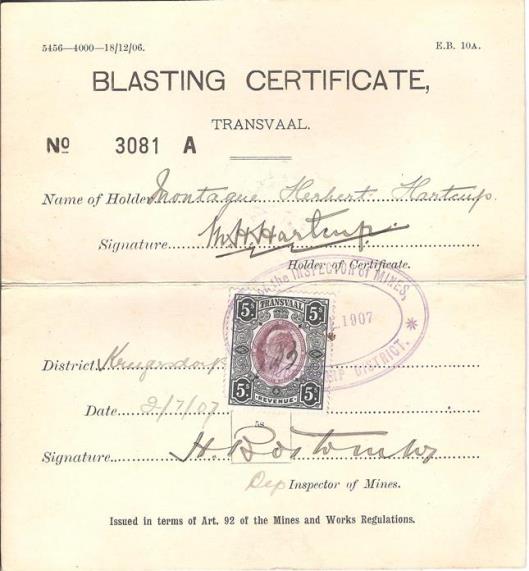
The certificate above is a new letterpress setting dated 18th December, 1906 with a print run of '4000' and is the only example I have seen with a machine score applied horizontally across the card so that it could be folded in half. There were foot treadle scoring machines available although this operating could also be achieved on a letterpress printing machine with a rule set in a form. All the others seen have been hand scored probably with the back of a knife and straight edge.
Postscript
Of particular interest would be the discovery of a ‘Duplicate’ or ‘Provisional’ Blasting Certificates.
* Here I have used the correct spelling from the period.
References
Transvaal Colony Proclamations from 1900-1902, revised to 30th November, 1902, London, Waterlow & Sons.
Transvaal Laws dealing with Mines, Works & Machinery and Mining Certificates, 1903, Published by Authority, Pretoria: 1903, pp.44 and 78-82.
The Transvaal Government Gazette, 31st July, 1903. Section VIII Explosives, Section IX Blasting, pp.271-286.
The Mining Certificates Ordinance 1903. Blasting Certificates, pp.163-164.
Transvaal Mines Department Annual Report, Government Engineer Year ending 30-June 1902 to 1904.
Mining Regulations. Johannesburg, 1906, Printed by Authority of The Government Engineer. Section IX, Blasting Act.92, p.70.
The mines, works and machinery regulations, 1911. Published by Authority, [1911] Johannesburg.
Woolgar, J., (2012), Blasting Certificate, The Transvaal Philatelist, Vol.47, No.1 (181), pp.32-33.
- - Messages from Transvaal Gold Mines - -
- - Back to Home page. - -
Copyright © J. Woolgar 2012 and 2025
- - o - -