Transvaal Dogs
The registration and control of dogs outside the areas of Municipalities
Jeff Woolgar
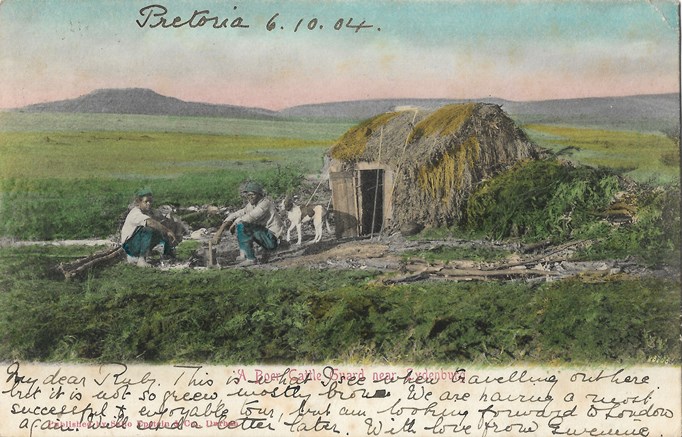
The caption in red ' A Boer Cattle Guard near Lydenburg ’ on a Sallo Epstein postcard was published in Durban and annotated in black ink “ Pretoria 6. 10. 04. ”. It entered the post two days later on 8th of October in Johannesburg, addressed to Palmers Green, London.
The message draws attention to the colours used were inappropriate for that of the landscape. This may also be the same for the dog.
When the British took control of the South African Republic from 1900 many of the Laws and Volksraad Resolutions were to remain in place, which included those for the control of dogs.
The Transvaal Colony Post Office was committed to providing services for other Government Departments, the revenue from which was mostly paid to the Treasury:
Custom Dues on dutiable packets,
Revenue Stamps sold at Post Offices,
Dog and Game Licences.
The Transvaal Administration Reports for 1904, under ‘Revenue and Expenditures / Collections of the Department, page ‘D.5’ record: In January 1904 the issue of Dog Licences at certain Country Offices was begun. The sun received was £427.12.0. and from 1st July 1905 £457.15.0.
However, the new Transvaal Legislative Assembly repealed these South African Republic laws, to take effect from the first day of January 1908.
Act, number 23 of 1907 was Promulgated on 26th August 1907 in order to consolidate and amend the Law relating to the registration and control of Dogs outside the areas of Municipalities. This new Law required those in the custody or control of a dog to register as soon as a dog was six months old and to renew annually. They were to receive a metal badge that would be stamped with the same number as the number on the certificate, the cost of which was two shillings and sixpence. However, for any dog that in the judgment of the person appointed to issue registration certificate, was a kind of ‘ Kaffir hunting dog ’ * or of a Greyhound strain or similar kind, the fee was five pounds. Moreover, if the metal badge or certificate were lost the replacement fee was two shillings and sixpence. For all other dogs the fee was ten shillings.
Fabrication of any document or the metal badge with intent was guilty of an offence and was liable on conviction to imprisonment with hard labour for a period not exceeding two years.
Nothing in this Act including the wearing of badges was for dogs kept within a municipality in which bye-laws were in force and made by the council for the licensing of dogs.
* A dog found across southern Africa of medium-sized with a short-coat, and a distinctive black patch found high on the outside of the tail where the caudal gland is found. Also called a ‘ painted dog ’ or ‘ Cape hunting dog ’.
The amount collected in 1906-1907 was £ 76,115 8s 6d. There was a reduction under each type of dog; except for Game Dogs.
Changed were made from the 1st January 1908, following The Registration and Control of Dogs Act, 1907; when the Post Office were no longer responsible for the issue of Dog Licenses. Instead Registration Certificates were to be only issued by the Receivers of Revenue and certain sub-Native Commissioners.
* A dog found across southern Africa of medium-sized with a short-coat, and a distinctive black patch found high on the outside of the tail where the caudal gland is found. Also called a ‘ painted dog ’ or ‘ Cape hunting dog ’.
References
Statutes of The Transvaal, 1907, Pretoria 1907, pp.155-158. Statute Law of the Transvaal 1839-1910 Vol. III 1907-1710 (Responsible Government) and Index, Compiled and Edited by Carl Jeppe, Pretoria, 1911.Transvaal, Department of Posts and Telegraphs, Annual Report for the Year ending 30th June, 1908, Pretoria, p.11.Volksraad Resolution Article 567 of 16th June 1887.First Volksraad Resolution Article 114 of 17th May 1893.Volksraad Resolution Article 6688 of 29th June 1898.
- - Back to Home page - -
Copyright © Jeff Woolgar 2026 and updated during June of that year
- - o - -