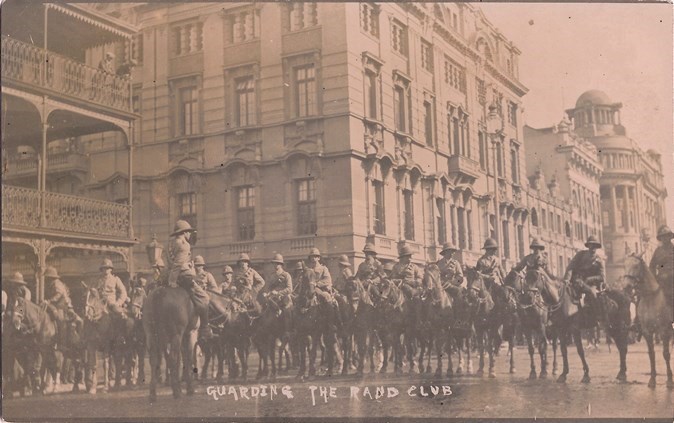
1913 MINERS STRIKE GUARDING THE RAND CLUB
Jeff Woolgar
The illustrated Star: Town and Country Journal, dated ‘ July 19, 1913 ’ has an illustration on page six, which shows the Rand Club, which was taken from a high building nearby. It is captioned: ‘Cavalry took up a position at the junction of Commissioner and Loveday Streets, by which they commanded all approaches to the north.’
The Postcard
The publisher of the photographic postcard above is not recorded; the picture has reversed out in white ‘ GUARDING THE RAND CLUB ’. The divided back is printed in black with an ink message taking up the whole card.
July 27th 1913. I am sending you two photos herewith being of the strike Days. This is a troop of the 10th Hussars in front of the Rand Club. It was from this particular Corner that the twenty eight victims found an easy grave. I myself, witness two people drop wounded within twenty yards of myself, in Commissioner St. &-not a hundred yards away from the Corner Ho[use] … I was out for love of adventure, the dangerously adding to the excitement Yours faithfully [initials].
There seems to be no compassion in the message, while the misfortune of those around him was just part of a day's entertainment. However, after the events of those few days, where at least two gun shops, one in President Street and the other opposite the Rand Club in Loveday Street were looted; some of the demonstrators were carrying weapons and mobs had roamed the streets of centre Johannesburg. Moreover, the strike began on 26th May and by 29th June all the mines were at a standstill and the first violence at Benoni had erupted. Some spectators may have been troubled at the first mass strike meeting in Johannesburg on the 4th July and held at the west end of Market Square, in spite of the fact it had been banned by the authorities, following hundreds of strikers who had marched from Germiston accompanied but a German Brass Band playing the " Marseillais ".
The mob attempted to set fire to several buildings, the Star newspaper editorial offices and part of Park Railway Station with success plus a few other prominent buildings. The Corner House * and The Rand Club † were two more prime targets in the city but they were frustrated by the force of police and army. Strikers fired at the police with the looted guns from the gun stores, the gun battle shattered shop windows and perhaps onlookers were killed.
-=-=-=-=-=--
* The ‘ Corner House ’ was the common name for the building of the ‘ Central Mining-Rand Mines ’ group of gold mines on the Witwatersrand. Originally established at Kimberley in 1876, it later moved to Johannesburg in 1887. From 1905 it became the ‘Central Mining and Finance Corporation ’, one of the largest companies dealing not only in minerals but diversifying into other merchandises.
† The Rand Club was in Loveday Street and among the membership were some of the most prominent Mining Magnates, men like Hermann Eckstein, Lionel Phillips and Julius Jeppe. The building was again attacked by miners during the 1922 strike.
Bibliography
Meet me at the Carlton, The story of Johannesburg&rsquos Old Carlton Hotel, Howard B. Trimmins (PTY), Cape Town (1972), pp.54-57.
The Barnett Collection, a pictorial record of early Johannesburg [Vol.1], (1966), ‘ The Star ’, Johannesburg, (Pages not numbered).
The Illustrated Star: Town and Country Journal, dated ‘ July 19, 1913 ’, p.6.
Thank you for reading this page.
- - 1914 General Strike - -
- - Back to Home page - -
Copyright © Jeff Woolgar 2025
- - o - -